[dropcap custom_class=”normal”] Christmas season is here again, what Christmas Gifts are you getting for your loved ones? You don’t know yet? Alright then, Bellafricana is here to the rescue *wink*
Christmas comes to bless the earth. It is a time for everybody to be happy and merry. But what makes this season more special to us all, are the type of gifts we give and get.
So we have drawn up a list of really creative Christmas gifts ideas for you to wow your loved ones. And hey, you can even decide to surprise your enemies with a yummy package for the festive season, spread the love to all men! Christ is born!!…[/dropcap]
[dropcap custom_class=”normal”] My first encounter with Chief (Mrs.) Nike Okundaye Davies was when I visited her Art Gallery at Ikate Elegushi roundabout Lekki-Epe Expressway, Lagos, Nigeria. She is a very lovely and amiable person and I am glad to do this write up on her.
Several years ago I saw a road sign saying “Nike Art”, on my way to my neighbour’s wedding. I think that was my first time of being awake while passing through Lekki-Epe expressway.
My name is Nike and I love art and every form it is presented in. So you can imagine how fast my attention was piqued when I saw this sign. That sign remained in my memory for a long time…. [/dropcap] Continue reading
[dropcap custom_class=”normal”] Are you familiar with that feeling of pure delight that comes when you see so many creativity such as Arts, Exhibition, Fashion etc. going on in one location? It’s spectacular!
This was the amazing feeling I got to experience at the GTBank Fashion Weekend. If you missed the event, here is a little recap to share the lovely experience with you…. [/dropcap] Continue reading
[dropcap custom_class=”normal”] Hello beautiful people, last weekend we partook in the 2nd and final Chevron Bazaar for the year 2016. The Chevron bazaar holds twice every year showcasing Afrocentric products from around Africa.
In this December edition, we represented several of our Bellafricana Verified business owners by displaying their products. There were so many beautiful and creative artisans present at the bazaar that had quite a lot of interesting works to display.
Come along! Let’s hold your hands and take you on a tour round the bazaar. Share the experience through our eyes (pictures)…. [/dropcap] Continue reading
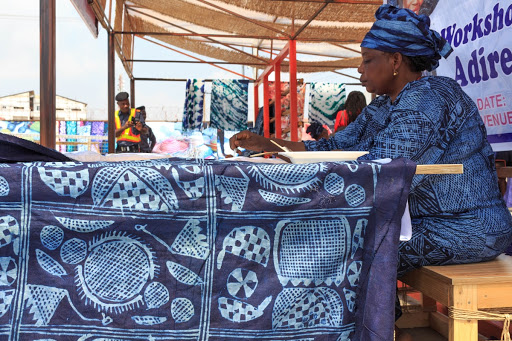
Adire textile, pronounced as Ah-DEE-reh is an age old indigo die textile indigenous to the Yoruba tribe of the Southwestern Nigeria. This textile is rich in beauty and culture as much as it has a rich history.
In this post, you will learn about the history of the Àdìre textile and follow its’ progression through time. How did the textile come about, where was it first made, who wore it first, how did it travel to other tribes and countries, where it is on the global sphere?
Yes, we had all these questions and more and knew many people out there too must have pondered on this also. To answer some of these questions, we at Bellafricana have done an extensive research on the subject to share the knowledge with the world. Let’s read on…
The Origin of Adire Textile
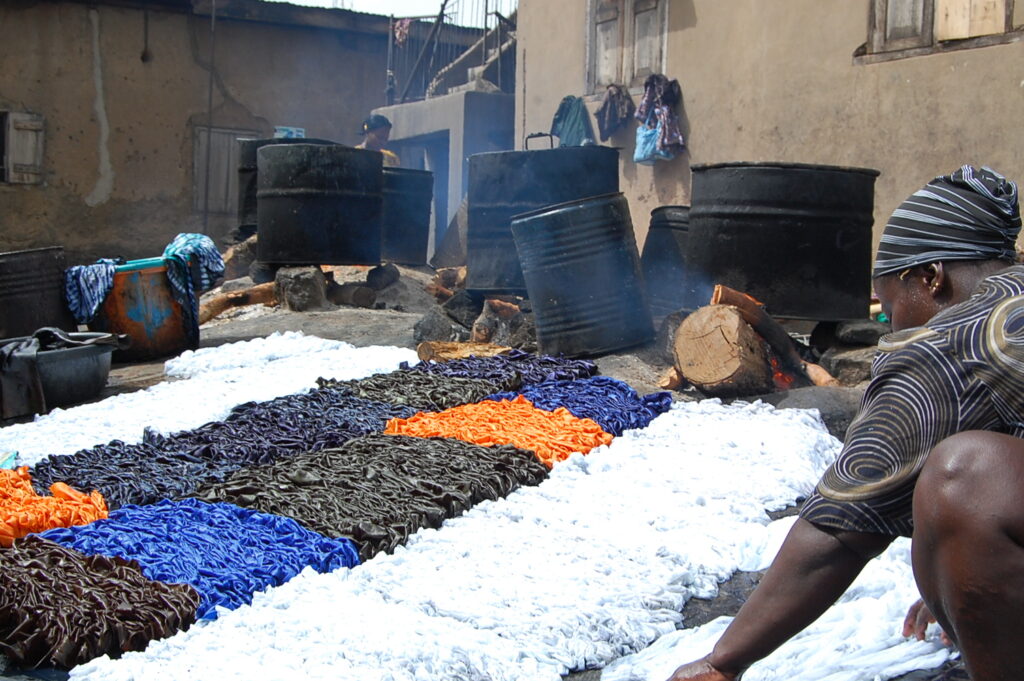
Let us begin with a little introduction for the benefit of those unfamiliar with this textile. Adire, is a Yoruba (a tribe in Southwestern Nigeria) word for tie and dye. It was first made by Yoruba women of old by using a variety of resist-dyeing techniques.
As the translation of the name suggests, the earliest pieces of Adire were probably simple tied designs on cotton cloth handspun and woven locally. [1]
I remember seeing a movie called “Odùduwà“, where the first wife of Oduduwa thought women how to tie and dye clothes. The ideology according to that movie’s story line was that before tie and dye textile came, clothes were only available in white colours.
While putting this write up together, we discovered that the origin of Adire might be traced to the archaeological discovery in some Tellem burial caves of Mali. Among the archeological findings, is a cap bearing the extant and popular Osubamba motif common in the Adire art of the Yoruba people.
This coupled with the fact that the Yoruba of Old Oyo kingdom exported their art across and beyond West Africa through trade, military activities and political dominance. [2]
I would say this supports the notion that Adire was first produced in Jojola’s compound of Kemta, Abeokuta by Chief Mrs. Miniya Jojolola Soetan, the second Iyalode (Head of Women) of Egba land. She then passed on the process to her children and onward to the future generations. [3]
The first Adire material was made with Teru (local white attire) and Elu (local Dye) made from elu leaf which is planted in the Saki area of Oyo state. There was an increase in tie-dye makers and artistic endeavours in the 20th century when more fabrics imported from European merchants became available for dyeing.
You might wonder, why bother tying the cotton fabric before dyeing it? The simple answer to that is, the tying method prevents the absorption of dye to the particular area of the fabric that is tied. [4]
In an academic research published in the Journal of African Studies, the researchers; Gausa Solomon and Abubakar Ezra, stated that Adire patterns are made by pleating of the cloth. This is done so that the colour is kept from inside of the folds by knotting and dyeing it or stitching with raffia fiber from banana leaves or thread. [5]
When more cotton fabrics to dye with became available in Nigeria, new techniques of resist dyeing were developed. According to Wikipedia, there are three primary resist techniques used in Nigeria presently:
Oniko: This process involves tying raffia around hundreds of individual corn kernels or pebbles to produce small white circles on a blue background. The fabric can also be twisted and tied on itself or folded into stripes. Alabere: Stitching raffia onto the fabric in a pattern prior to dyeing. The raffia palm is stripped, and the spine sewn into the fabric. After dyeing the raffia is usually ripped out, although some choose to leave it in and let wear and tear on the garment slowly reveal the design. Eleko: Resist dyeing with cassava paste painted onto the fabric. Traditionally done with different sizes of chicken feathers, calabash carved into different designs etc., in a manner similar to block printing. Since the early twentieth century, metal stencils cut from the sheets of tin that lined tea chests have also been used.
The simplest design for tie and dye is made by pulling up portions of the cloth at an interval, and either knotting or binding round them before dyeing. The tied portion is later removed after dyeing thereby creating a pattern of circles.
Related Post: Nike Art Gallery
In some situations, seeds or pebbles are sometimes tied into the cloth to create patterns. Also, some impressions may be sown into the fabric with thread and the stitches drawn up tightly before dyeing
Click play below to watch the video documentary of Adire textile amongst Yorubas by Thorolf Lipp.
Adire’s Journey Through The Globe
So many skills of African heritage were transported from country to country or entirely out of the continent through traders. Some of these transition came about either through adventurous traders who traded goods from country to country or through avenues such as slave trading.
Related Post: African Black Soap: The History, Components and Benefits
During the slave trade many slaves were skilled in weaving; the skill was used by the slave owner as another form of income. This is one of the ways some part of the African cultural heritage travelled from one continent to the other.
In those days, textiles were also used as a form of identity with each tribe having their own unique patterns which also made it easy to spot outsiders. In the case of Adire, it is said that for a long time, people who were not from certain families were not allowed to partake in tie-dye production as it was a part of the family’s heritage.
History has it that the tie-dye technique became recognised as a form of art in several countries across the globe. A publication on Tie-Dye US has it that, tie and dye became all the rage during the Vietnam War period.
This was when people craved peace and freedom from the starched idea of parents and authority. Then, tie-dye was a form of artistic expression (as well as protest) for the hippie, psychedelic generation who were free spirited and uninhibited during this difficult time in American history.
These artistic peace-lovers embellished t-shirts, curtains, tapestries, pants, and anything else that would proclaim their individuality! Tie-dye made people happy then, as it does today! It has remained the utmost symbol of the sixties! And, in all it’s forms, tie-dye is not only an art of fabric, but a piece of our world history. [6]
In clothing, there are endless possibilities in what you can do. Our founder at Bellafricana, Bukky Asehinde, can’t get enough of the Adire textile. I added a lovely picture of her looking absolutely stunning in one of her dresses made from adire.
Bukky Asehinde and Mr Olusegun Awolowo wearing Adire textile
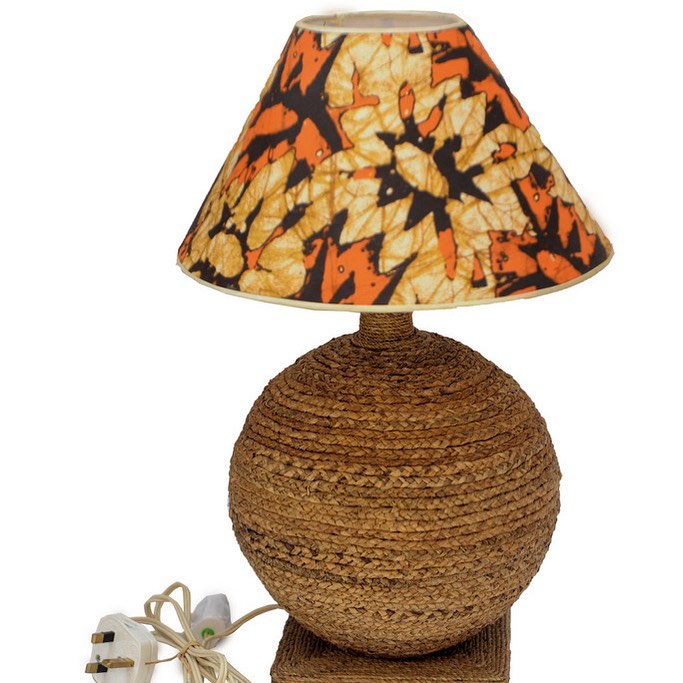
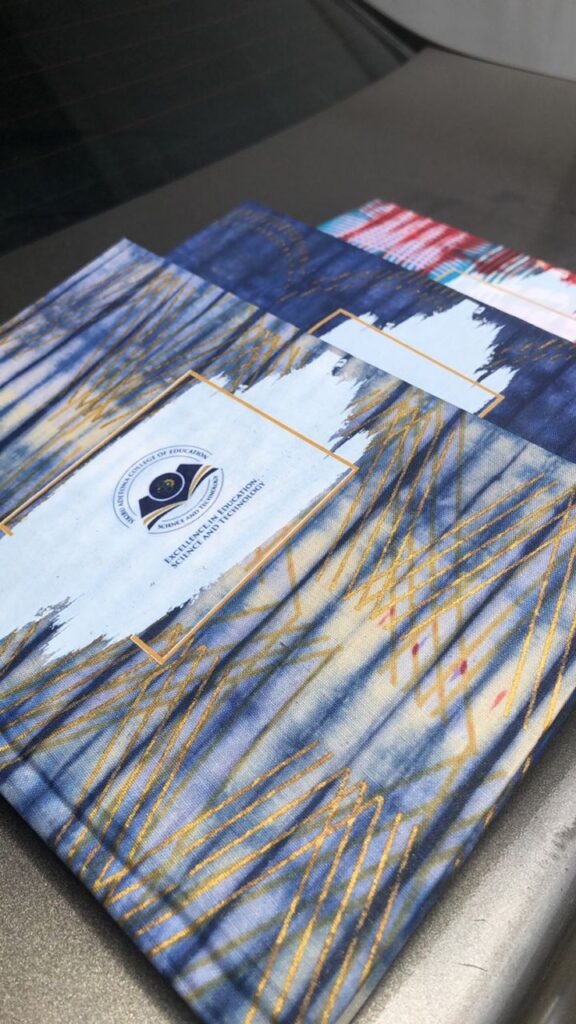
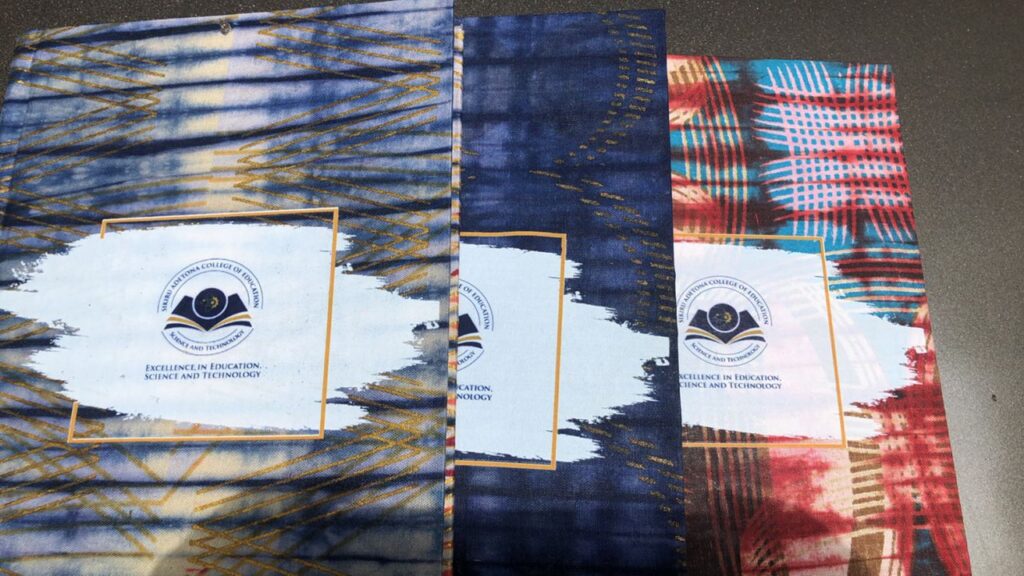
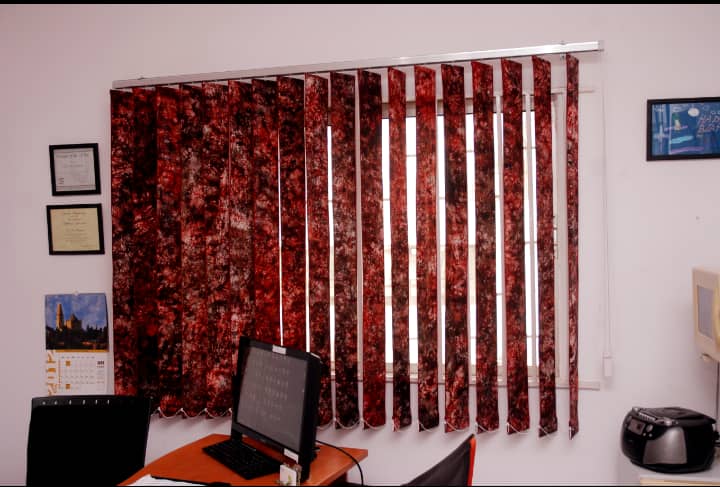
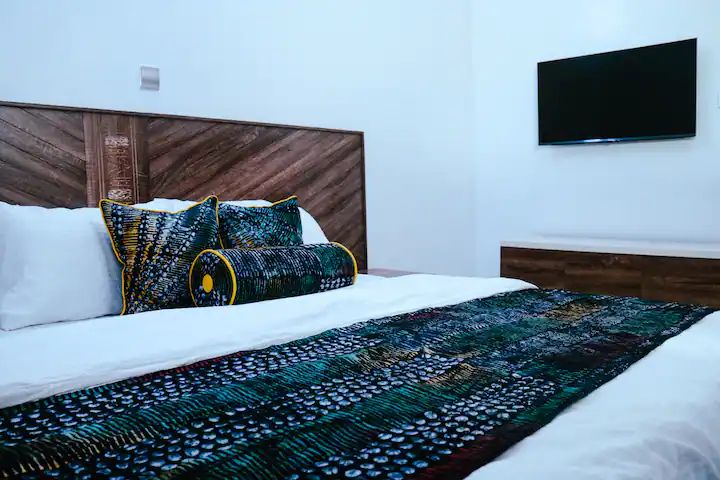
Today, the Adire textile is no longer limited to being used as clothing material alone. It is now being used creatively in different ways. You can use it to make note books, throw pillows, wall arts, lamp shades etc.
You will see below, the way Bellafricana creatively uses Adire on the books we produce on commission as souvenirs for clients’ weddings, birthdays, company events and so much more. The textile comes out so beautifully and perfectly that you might be tempted to keep them all for yourself instead of handing them out to your guests eventually. This is true for most our books really.
Bellafricana Adire Notebooks for Gifts
Adire blinds by Catyna Designs on BellafricanaAdire throw pillows by Catyna Designs using Asologe adire fabrics
[1] Wikipedia – Adire (Textile Art)
[2] African Research Review: An International Multidisciplinary Journal, Ethiopia Vol. 7 (2), Serial No. 29, April, 2013:350-370 by Areo, Margaret Olugbemisola and Kalilu, Razaq Olatunde Rom
[3] The Guardian – A Short History of Adire
[4] Emur Ogumor (1993:110). Certificate Art for Junior and Senior Secondary School. Ibadan: University Press Ltd.
[5] Mgbakoigba: Journal of African Studies, Volume 4, 2015. TIE – DYE (ADIRE) AMONG THE JUKUN PEOPLE by Gausa Solomon and Abubakar Ezra
[6] Tie-die US – Tie-dye Through the Ages – A History of Tie-dye
[dropcap custom_class=”normal”] 360Creative Hub has something really special for fashion entrepreneurs and enthusiasts based in Lagos. Fashion is arguably the next big deal in Nigeria and as such, has seen many entrepreneurs emerge than most special crafts in Nigeria. Their needs range from machinery to office space where they can work and create, to runways where they can flaunt their creativity.
Real Estate in Lagos can be a business killer hence the need to create a workspace for these bubbly entrepreneurs to express themselves, free from financial inhibition. Space where they can find specific materials for production and a chance at mentoring and professional advice. A space like 360Creative Hub… [/dropcap] Continue reading
[dropcap custom_class=”normal”] Yemi Alade, the popular Nigerian songstress known for her signature-look bold African hairstyle, has claimed her title as the King of Queens once again. Recently, she featured in Shell‘s #makethefuture campaign and she really made us proud as she is the only African featured in the music video.
Yemi, born as Yemi Eberechi Alade, started her climb to stardom when she won the 2009 Peak Talent Show. Ever since, she has been soaring high beautifully and breaking ground after grounds… [/dropcap] Continue reading
[dropcap custom_class=”normal”] So many people go for the American dream, but the founders of Wilson’s Juice are of a different opinion. They believe that the Nigerian dream is alive, strong and valid. In their words to CNN, ‘In Nigeria, you can have a Naira and a dream’.
The Wilson’s Juice Company was created in 2010 with a starting capital of just ₦2000 ($10) by 2 brothers, Seyi and Seun Abolaji. This company has since turned to a very lucrative business for the brothers… [/dropcap] Continue reading
[dropcap custom_class=”normal”] Lagos Island is like a gold mine being sat on. It can be the focal point for promoting our history and culture, raking in major revenue through tourism for the government and private sector; this can be a plausible solution to the Naira hyper inflation… [/dropcap] Continue reading
[dropcap custom_class=”normal”] I would like to thank one of my oldest friends Bukky for giving me this platform to write on my opinions. I remember when we first discussed it, it was just after I had returned from a ‘romantic’ travel, she wanted me to write an article on my Zanzibar experience which I did and after putting that in I suppose she really liked it and we talked about writing twice monthly for her site or so, now I knew deep down I had a lot on my plate and as such couldn’t be so committed to writing that often or according to a schedule.
I did tell her straight up I couldn’t write that often, still I considered it and actually tried, I discovered two things;
1) That I couldn’t just will myself to write, even when I tried to go off and be by myself to be in that mental space then I had a talk with her, even though I wasn’t detailed she assured me I was under no pressure, I could write as I felt and totally do me.
2) I didn’t realize when she said I could write about anything I could actually write about anything, I was having trouble coming to terms with the idea that as this was a site promoting Africa/made in Africa all my writing had to be in line with that.
So rein in tight and get ready to read about a broad spectrum of my interesting take and thoughts on happenings with Africa as a centre stage and beyond. [/dropcap] Continue reading
We use cookies on our website to give you the most relevant experience by remembering your preferences and repeat visits. By clicking “Accept”, you consent to the use of ALL the cookies.
This website uses cookies to improve your experience while you navigate through the website. Out of these, the cookies that are categorized as necessary are stored on your browser as they are essential for the working of basic functionalities of the website. We also use third-party cookies that help us analyze and understand how you use this website. These cookies will be stored in your browser only with your consent. You also have the option to opt-out of these cookies. But opting out of some of these cookies may affect your browsing experience.
Necessary cookies are absolutely essential for the website to function properly. These cookies ensure basic functionalities and security features of the website, anonymously.
Cookie
Duration
Description
cookielawinfo-checbox-analytics
11 months
This cookie is set by GDPR Cookie Consent plugin. The cookie is used to store the user consent for the cookies in the category "Analytics".
cookielawinfo-checbox-functional
11 months
The cookie is set by GDPR cookie consent to record the user consent for the cookies in the category "Functional".
cookielawinfo-checbox-others
11 months
This cookie is set by GDPR Cookie Consent plugin. The cookie is used to store the user consent for the cookies in the category "Other.
cookielawinfo-checkbox-necessary
11 months
This cookie is set by GDPR Cookie Consent plugin. The cookies is used to store the user consent for the cookies in the category "Necessary".
cookielawinfo-checkbox-performance
11 months
This cookie is set by GDPR Cookie Consent plugin. The cookie is used to store the user consent for the cookies in the category "Performance".
viewed_cookie_policy
11 months
The cookie is set by the GDPR Cookie Consent plugin and is used to store whether or not user has consented to the use of cookies. It does not store any personal data.
Functional cookies help to perform certain functionalities like sharing the content of the website on social media platforms, collect feedbacks, and other third-party features.
Performance cookies are used to understand and analyze the key performance indexes of the website which helps in delivering a better user experience for the visitors.
Analytical cookies are used to understand how visitors interact with the website. These cookies help provide information on metrics the number of visitors, bounce rate, traffic source, etc.
Advertisement cookies are used to provide visitors with relevant ads and marketing campaigns. These cookies track visitors across websites and collect information to provide customized ads.