[dropcap custom_class=”normal”]The town is peaceful, tranquil and receptive. It is blessed with so much history, an enticing festival, cuisine and hospitality that attracts tourists and visitors yearly to the town. Ijebu-Ode is a local government in Ogun State, South-West; Nigeria. The state is hugely popular for being the home of the revered Olumo Rock and Lisabi Festival. The nomenclature Ijebu-Ode is the combination of two great personalities and founders of the town-Ajebu and Olode. Both families were the first settlers in the ancient town. A total of 154,032 reside in the town. It is dominated by the Ijebus and Ijebu is their lingua franca.[/dropcap]Continue reading
[dropcap custom_class=”normal”] Bukky Bello who is the founder of Bellafricana shares with Bellafricana digest viewers the launch of an online marketplace for Afrocentric and Handmade products in Africa (starting with Nigeria her homeland) with the aim of promoting local content through the connection of local artisans, talents and creatives to the global reach. Let’s hear her story… [/dropcap]
[dropcap custom_class=”normal”] I have stalled on writing this article for a while now, but I think now is the time to finally complete and share it. I don’t know if it’s the same with you, but most times, your spirit is led to do something and when you refuse to do it, things or people around you leave clues for you to make your decision. [/dropcap]
Now, let’s get to the topic shall we, because as you all may not know “I can talk for Africa”… Continue reading
[dropcap custom_class=”normal”]A talking drum is an ancient hourglass shaped African instrument. It is created by the Yoruba people of Nigeria and the Ashanti people of Ghana . It is also called a “waisted” drum because it has an hourglass shape with a “waist” in the middle. [/dropcap]Continue reading
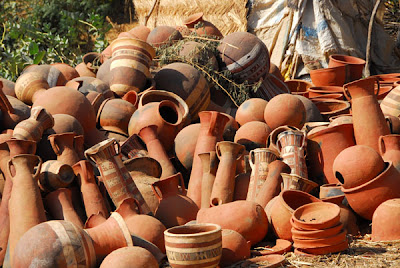
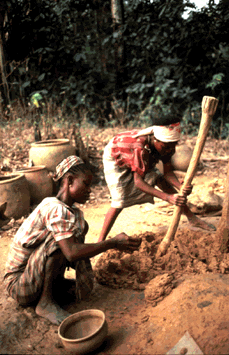
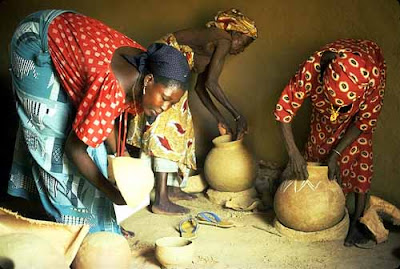
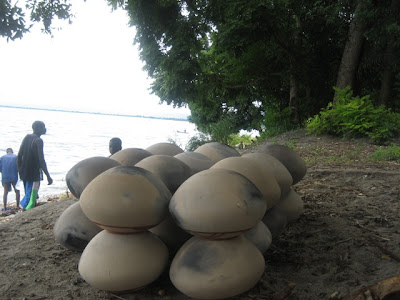
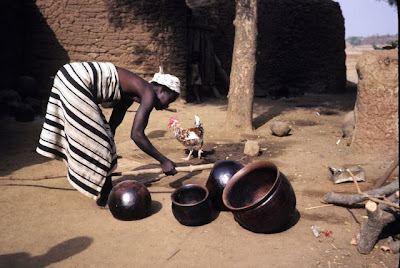
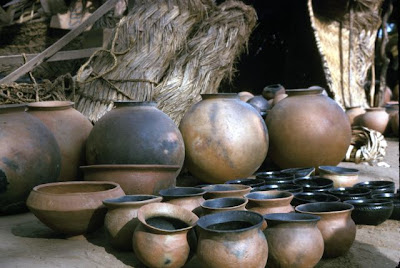
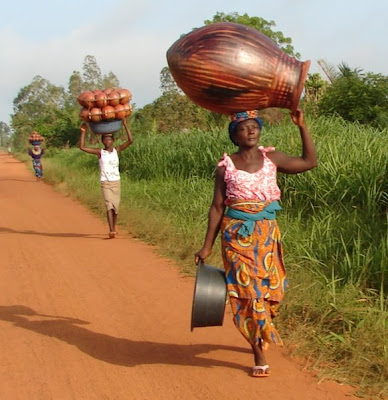
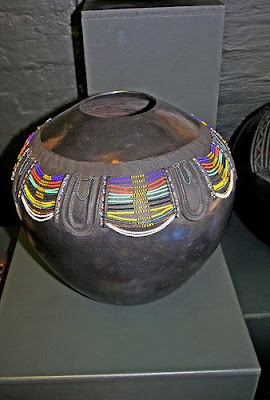
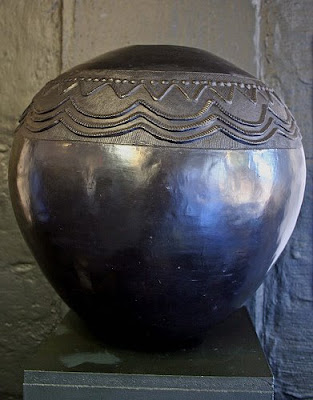
Pottery has a long history in Africa and is one of the oldest arts. Pots are usually made by women. Though cheap and functional, African pots combine utility with great beauty. The procedure for making pots vary within the different communities that span the continent. The process of pottery making in Africa begins with the mining and preparation of the clay and mixing it with water.
Women Mining Clay
Women mining clay
Photos by Prof. Christopher Roy
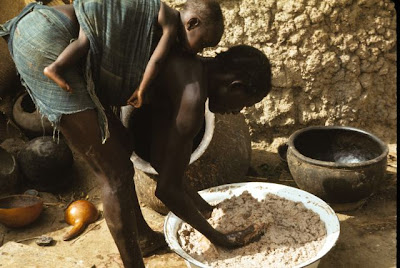
Clay Preparation
Temper or inert matter is then added to the clay mixture so as to reduce plasticity and to decrease shrinkage of pottery by replacing clay molecules, which contain water that shrink during drying and firing.
Photos by Prof. Christopher Roy
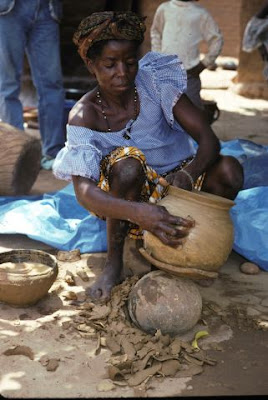
Temper includes finely chopped straw, dried animal dung pounded into a powder, and the chaff left when rice or millet is winnowed to prepare it for cooking, sand, river pebbles, shards of old pottery which have been reduced to a find powder. Tempers are kneaded into the fresh clay in amounts that vary. Generally, the result is a clay body with thirty to fifty percent temper material.
Photos by MjengwaPhotos by Mjengwa
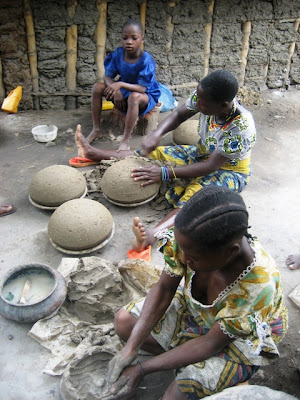
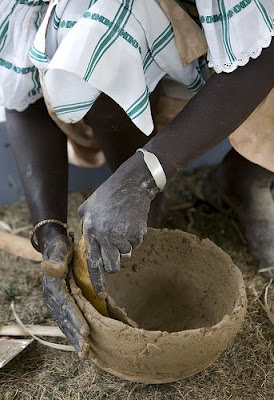
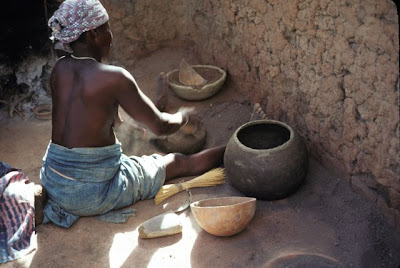
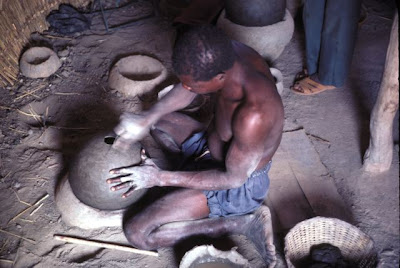
Starting with a mass of clay, most potters work by punching a hole in the center, and pulling the clay apart to give a vessel shape. Some flatten a clay shape over a convex mold and build up a vessel with coils. The potter’s wheel is uncommon in Africa. When they are ready for firing, a few large pots and many small ones are stacked together. Then they are wood fired for about three hours at relatively low temperatures. Some communities use pits and kilns.
Photos by Prof. Christopher RoyPhotos by Prof. Christopher RoyPhotos by Prof. Christopher Roy
Pre-firing decoration is generally permanent and will survive handling and extensive use of the pot. In contrast, post-firing decoration, such as painting or colored washes, never becomes an integral part of the pot and will eventually wear off the surface.
Photos by Prof. Christopher Roy
Pre-firing decoration is applied at different stages in the drying process, after the completion of the basic shape of the pot and before the firing. Simple decorations include ones incised into the damp clay with a sharp blade or comb-like tool, impressed with a stamp made for example from split seed pods or shells, or rolled with a roulette made from a dried corn cob from which the kernels have been removed. Pre-firing also helps to drive the last molecules of absorbed water between the clay particles.
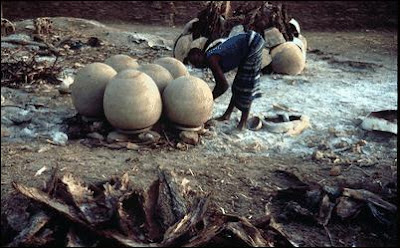
Here a potter of the Konate family in the village of Ouri in Burkina Faso prepares to fire large jars that will be used for brewing millet beer.
Photos by Prof. Christopher Roy
To pre-fire larger pots, they are turned rim downward on three large stones which keep them off the ground. A small fire is built beneath each pot to complete the drying process. When the pots are sufficiently dry, they are stacked with others for the final firing. The final firing must be begun before the pots have cooled from the pre-firing. If pottery is allowed to cool after the pre-firing, it will re-absorb moisture from the atmosphere and will crack during the final firing. Pre- firing is usually not necessary in the dry savanna where the lack of humidity permits more complete drying of the pottery before firing.
FIRING IN A KILN
Photos by Prof. Christopher RoyPhotos by Prof. Christopher Roy
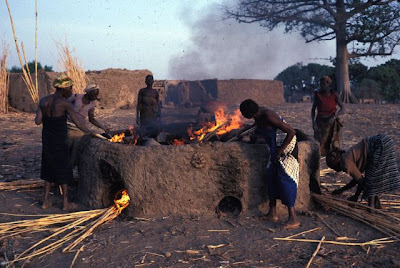
The kiln consists of a low, circular, mud brick wall, with pierced small holes on the base of the which provides air for the firing. Some kilns also have one or more larger holes that permit the addition of fuel during the course of the firing.
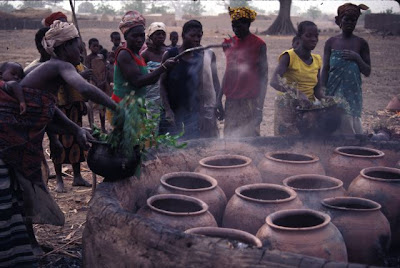
A thick layer of fuel is laid over the bottom of the kiln. Then, the dry pottery, interspersed with additional fuel, is piled on top which is then covered with large pieces of broken pottery that helps retain some heat and protect the pottery from direct contact with cool air. The kiln is lit from the bottom.
Photo by Mjengwa
The duration of African firings is very short when compared to the technically complex and lengthy firings of European, American, and Oriental potters.
Photos by Prof. Christopher Roy
Once pottery has been fired its basic shape cannot be altered.
Photos by Prof. Christopher RoyPhoto by HobotravelerPhoto by Hobotraveler
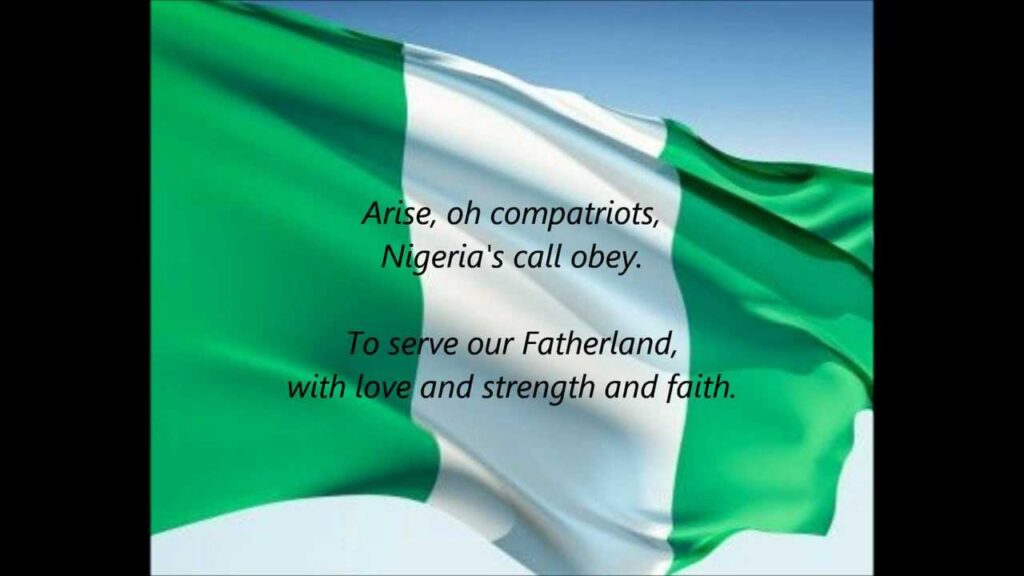
Nigeria’s national anthem [Arise, O Compatriots Lyrics] – past to present.
Nigeria used the British National anthem “God Save the Queen” as her patriotic song in the year 1914 to 1960. After its Independence in 1960, “Nigeria We Hail Thee” became the national anthem and was written by Lillian Jean Williams with music by Frances Benda, both were British expatriates.
During the Nigerian civil war which lasted from 1967-1970, when Biafra tried to secede from Nigeria, “Nigeria We Hail Thee” was the anthem of the home country while Biafra’s anthem was “Land of the Rising Sun”. After the war in which Nigeria won to stay one country, Biafra’s anthem was no longer in use. In 1978, the National Publicity Committee organized a contest to create a new national anthem, of the many sent in, five stood out and they were words written by John A. Ilechukwu, Eme Etim Akpan, B. A. Ogunnaike, Sotu Omoigui and P.O. Aderibighe.
These words were put together to form what is now the “Arise, O Compatriots“, the Nigerian national anthem. At the time, Nigeria was under military rule and the music to the anthem was composed by the Nigerian Police Band, Benedict Elide Odiase was the director at the time. The “Arise, O Compatriots” has since been the official patriotic song of Nigeria.
Arise, O Compatriots(1978–present)
Arise, O compatriots,
Nigeria’s call obey
To serve our Fatherland
With love and strength and faith.
The labour of our heroes past
Shall never be in vain,
To serve with heart and might
One nation bound in freedom, peace and unity.
O God of all creation
Direct our noble cause
Guide our leaders right
Help our youth the truth to know
In love and honesty to grow
And living just and true
Great lofty heights attain
To build a nation where peace
And justice shall reign.
“Nigeria, We Hail Thee” (1960-1978)
Nigeria, we hail thee,
Our own dear native land,
Though tribe and tongue may differ,
In brotherhood, we stand,
Nigerians all are proud to serve
Our sovereign Motherland.
Our flag shall be a symbol
That truth and justice reign,
In peace or battle honoured,
And this we count as gain,
To hand on to our children
A banner without stain.
O God of all creation,
Grant this our one request,
Help us to build a nation
Where no man is oppressed,
And so with peace and plenty
Nigeria may be blessed.
“Biafra National Anthem” (1967-1970)
Land of the rising sun, we love and cherish,
Beloved homeland of our brave heroes;
We must defend our lives or we shall perish,
We shall protect our hearts from all our foes;
But if the price is death for all we hold dear,
Then let us die without a shred of fear.
Hail to Biafra consecrated nation,
Oh, fatherland, this be our solemn pledge:
Defending thee shall be a dedication,
Spilling our blood we’ll count a privilege;
The waving standard which emboldens the free
Shall always be our flag of liberty.
We shall emerge triumphant from this ordeal,
And through the crucible unscathed we’ll pass;
When we are poised the wounds of battle to heal,
We shall remember those who died in mass;
Then shall our trumpets peal the glorious song
Of victory, we scored o’er might and wrong.
Oh God, protect us from the hidden pitfall,
Guide all our movements lest we go astray;
Give us the strength to heed the humanist call:
‘To give and not to count the cost” each day;
Bless those who rule to serve with resoluteness,
To make this clime a land of righteousness.
National Pledge
The Pledge is recited immediately after the National Anthem;
I pledge to Nigeria my country
To be faithful, loyal and honest
To serve Nigeria with all my strength
To defend her unity, and uphold her honour and glory
So, help me, God.
[dropcap custom_class=”normal”]Song of Abidjan is Côte d’Ivoire’s national anthem. it was adopted at the country’s independence in 1960. The anthem is strongly influenced by religion and tinged with patriotism. The lyrics are from ministers Mathieu Vangah Ekraand Joachim Bony.[/dropcap]Continue reading
[dropcap custom_class=”normal”] God bless our homeland was composed and penned by Philip Gbeho in 1957. Upon independence, the original words to this anthem were changed in 1960 when Ghana became a republic. Six years later, the government was overthrown and a new lyrics was sourced for through a contest in 1966 after the coup in Ghana. Michael Kwame Gbordzoe lyrics was chosen and it replaced Philip Gbeho’s lyrics in the 1970s. [/dropcap]Continue reading
South Africa’s national anthem is a combined version of “Nkosi Sikelel’ iAfrika” and “The Call of South Africa” composed by Enoch Sontonga in 1897 and CJ Langenhoven in 1918. The combined version became South Africa’s official national anthem in 1997.
It is the only national anthem that starts in one key and ends in another. The lyrics are written South Africa’s most populous official languages – isiXhosa, isiZulu, seSotho, Afrikaans and English. The first stanza of the anthem is written in Xhosa and Zulu, the second stanza is written in Sesotho while the last two stanza are written in Afrikaans and English.
South Africa’s national anthem lyrics
Lord bless Africa
May her glory be lifted high
Hear our petitions
Lord bless us, your children
Lord we ask You to protect our nation
Intervene and end all conflicts
Protect us, protect our nation
Protect South Africa, South Africa
Out of the blue of our heavens
Out of the depths of our seas
Over our everlasting mountains
Where the echoing crags resound
Sounds the call to come together,
And united we shall stand,
Let us live and strive for freedom,
In South Africa our land.
We use cookies on our website to give you the most relevant experience by remembering your preferences and repeat visits. By clicking “Accept”, you consent to the use of ALL the cookies.
This website uses cookies to improve your experience while you navigate through the website. Out of these, the cookies that are categorized as necessary are stored on your browser as they are essential for the working of basic functionalities of the website. We also use third-party cookies that help us analyze and understand how you use this website. These cookies will be stored in your browser only with your consent. You also have the option to opt-out of these cookies. But opting out of some of these cookies may affect your browsing experience.
Necessary cookies are absolutely essential for the website to function properly. These cookies ensure basic functionalities and security features of the website, anonymously.
Cookie
Duration
Description
cookielawinfo-checbox-analytics
11 months
This cookie is set by GDPR Cookie Consent plugin. The cookie is used to store the user consent for the cookies in the category "Analytics".
cookielawinfo-checbox-functional
11 months
The cookie is set by GDPR cookie consent to record the user consent for the cookies in the category "Functional".
cookielawinfo-checbox-others
11 months
This cookie is set by GDPR Cookie Consent plugin. The cookie is used to store the user consent for the cookies in the category "Other.
cookielawinfo-checkbox-necessary
11 months
This cookie is set by GDPR Cookie Consent plugin. The cookies is used to store the user consent for the cookies in the category "Necessary".
cookielawinfo-checkbox-performance
11 months
This cookie is set by GDPR Cookie Consent plugin. The cookie is used to store the user consent for the cookies in the category "Performance".
viewed_cookie_policy
11 months
The cookie is set by the GDPR Cookie Consent plugin and is used to store whether or not user has consented to the use of cookies. It does not store any personal data.
Functional cookies help to perform certain functionalities like sharing the content of the website on social media platforms, collect feedbacks, and other third-party features.
Performance cookies are used to understand and analyze the key performance indexes of the website which helps in delivering a better user experience for the visitors.
Analytical cookies are used to understand how visitors interact with the website. These cookies help provide information on metrics the number of visitors, bounce rate, traffic source, etc.
Advertisement cookies are used to provide visitors with relevant ads and marketing campaigns. These cookies track visitors across websites and collect information to provide customized ads.