
Ibrahim Mahama: Using Everyday Materials to Question Labor and Value

African artists have long been present in global art spaces. Their work has travelled widely, been exhibited internationally, and discussed across institutions. But presence alone is not the same as authorship.

What feels different today is how some African artists are no longer simply responding to global platforms, but actively shaping the conversations within them. Their work does not ask for permission to belong. It arrives with context, intention, and its own language.

Ibrahim Mahama is one of those artists. The Ghanaian artist, born in Tamale in northern Ghana, continues to live and work between Tamale and Accra, creating installations that challenge how we see labor, material, and memory.

Who Is Ibrahim Mahama?

Growing up in Tamale meant growing up close to markets, trade routes, and the everyday realities of labor. As a result, goods were constantly moving. Objects passed through many hands. Work was visible and physical.

These early environments shaped how Ibrahim Mahama understands material. For him, materials are not neutral or decorative. Instead, they carry memory. Each one holds evidence of use, movement, and time.

This perspective sits at the core of his practice today.

Materials as Records, Not Objects

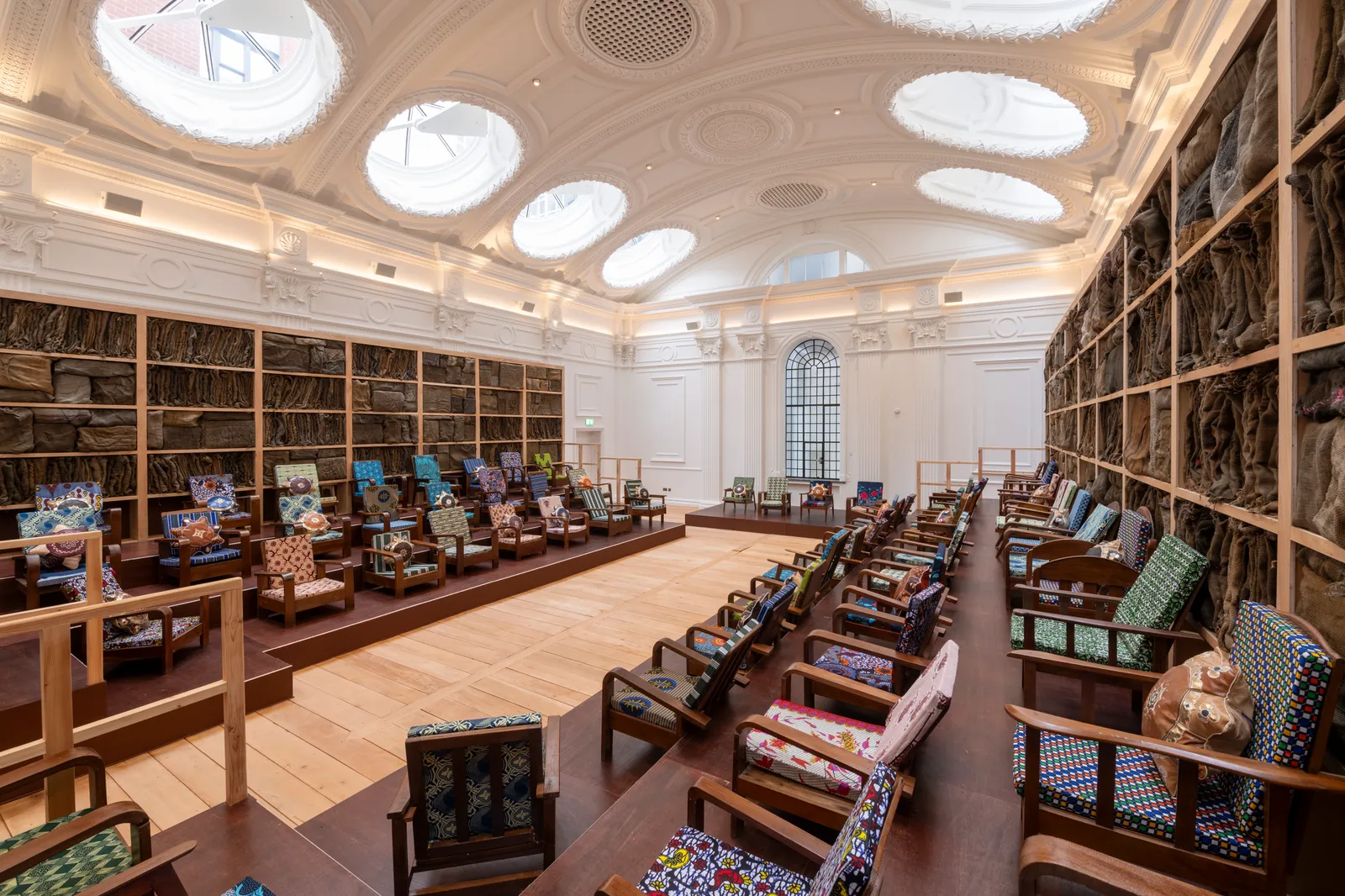
Ibrahim Mahama is best known for working with found and repurposed materials such as jute sacks, wooden crates, ropes, and aluminum objects. Many of these materials are sourced from markets and transport systems and still carry stains, tears, stamps, and dents from previous use.

Rather than hiding these marks, Mahama keeps them visible. Moreover, he centers them.

In his work, materials function as records of labor, trade, and migration. They point to global economic systems while remaining grounded in specific places and bodies. His installations often take over entire buildings or public spaces, interrupting familiar environments and forcing viewers to confront what is usually overlooked.
The Headpans: Making Labor Impossible to Ignore

One of Mahama’s most memorable bodies of work involves aluminum headpans, everyday objects commonly used by market traders and porters across Ghana and other parts of West Africa. These headpans are tools of survival. In practice, they carry goods, weight, and repetition. They are deeply familiar, yet rarely noticed.

This material appears powerfully in Zilijifa, Mahama’s solo exhibition at Kunsthalle Wien in Vienna. At the center of the show was a striking installation titled The Physical Impossibility of Debt in the Mind of Something Living (2025).

The work brought together a decommissioned diesel locomotive, once used on Ghana’s colonial-era railway lines. Beneath it, thousands of enameled iron headpans formed a dense field. Mahama collected these headpans by exchanging new ones for used ones, ensuring that each carried a visible history of labor.

The pans were battered, dented, and chipped. They were not decorative.

In the context of the installation, they functioned as physical traces of labor itself. They pointed to the human effort that sustains systems of trade, transport, and movement. Consequently, what is usually ordinary became unavoidable.

By relocating these objects into an art space, Mahama shifted how they are read. The work prompted conversations around visibility, value, and the labor that underpins economic systems, particularly within African contexts. Rather than romanticizing labor, the work insisted that it be seen.
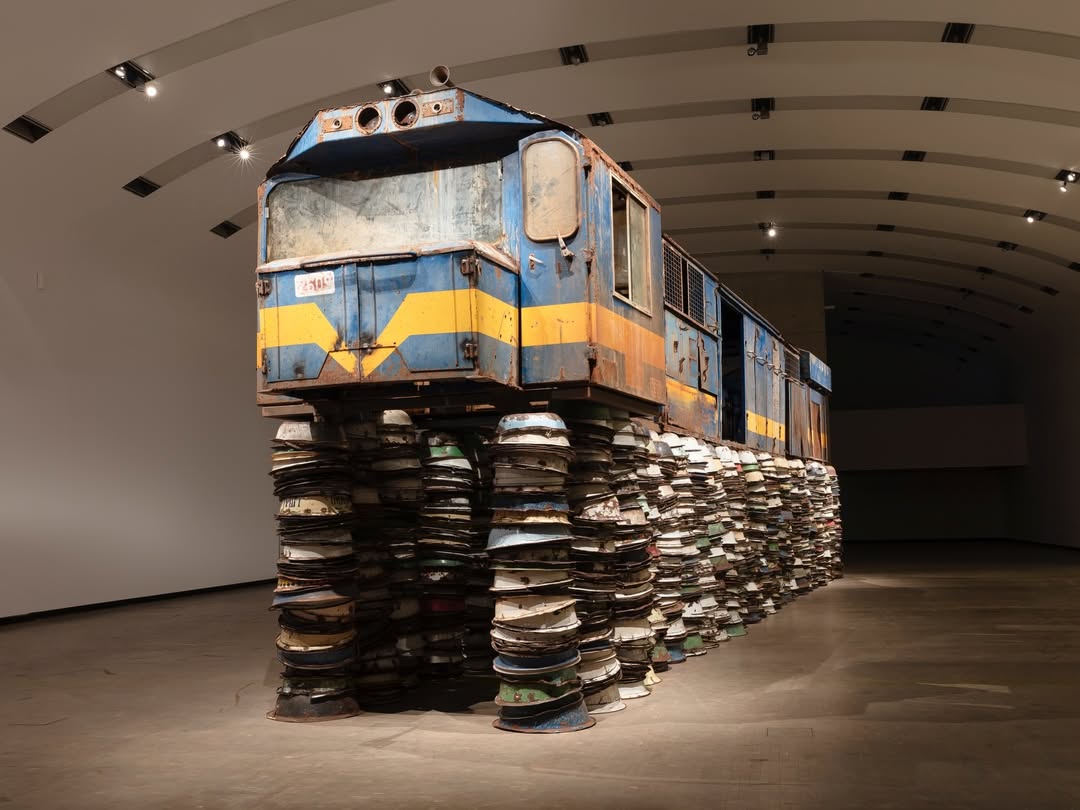
Used headpans under a locomotive highlight the labor behind global trade.

From Local Histories to Global Systems

This insistence on context follows Mahama wherever his work travels.

His installations do not change meaning when they move internationally. Instead, they expand. Furthermore, the same materials that speak to local labor histories in Ghana begin to reveal global connections when placed in international spaces.

This was especially evident in Ibrahim Mahama’s solo exhibition Digging Stars, presented in Singapore during Singapore Art Week from 16 January to 8 February 2026. Singapore, as a global hub for trade, logistics, and commerce, is deeply tied to the systems Mahama’s materials come from.
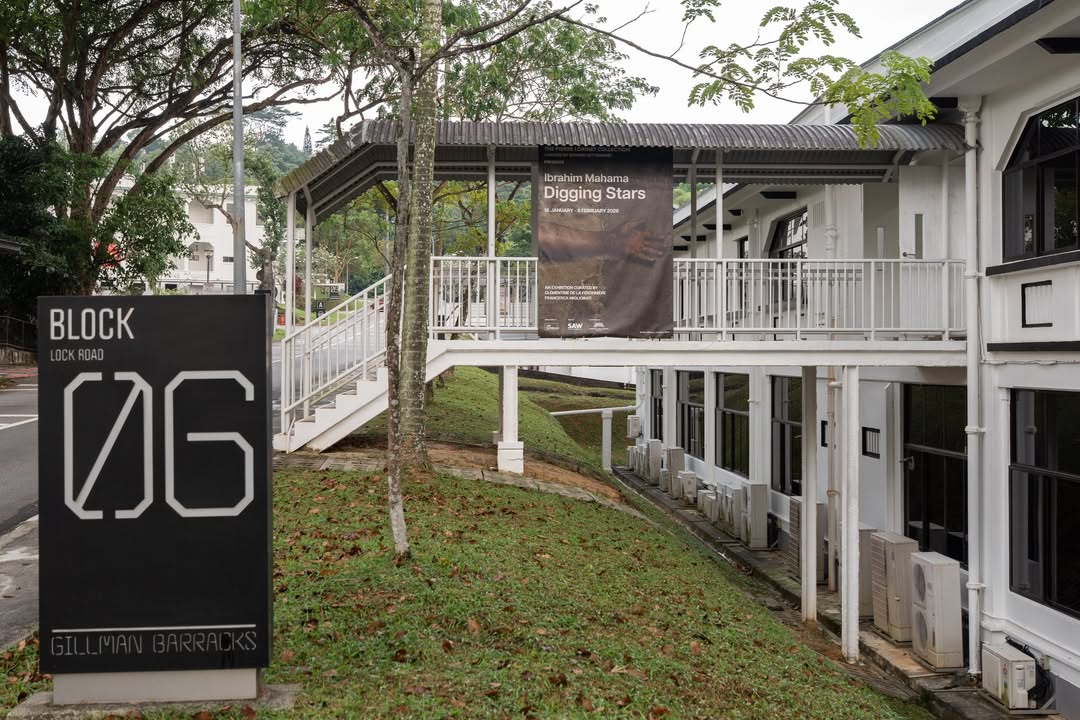
The exhibition brought together fabric works, installations, photography, and video, continuing his long-term exploration of labor, material, and value. Rather than presenting African experience as distant or separate, the work highlighted how interconnected global systems truly are.
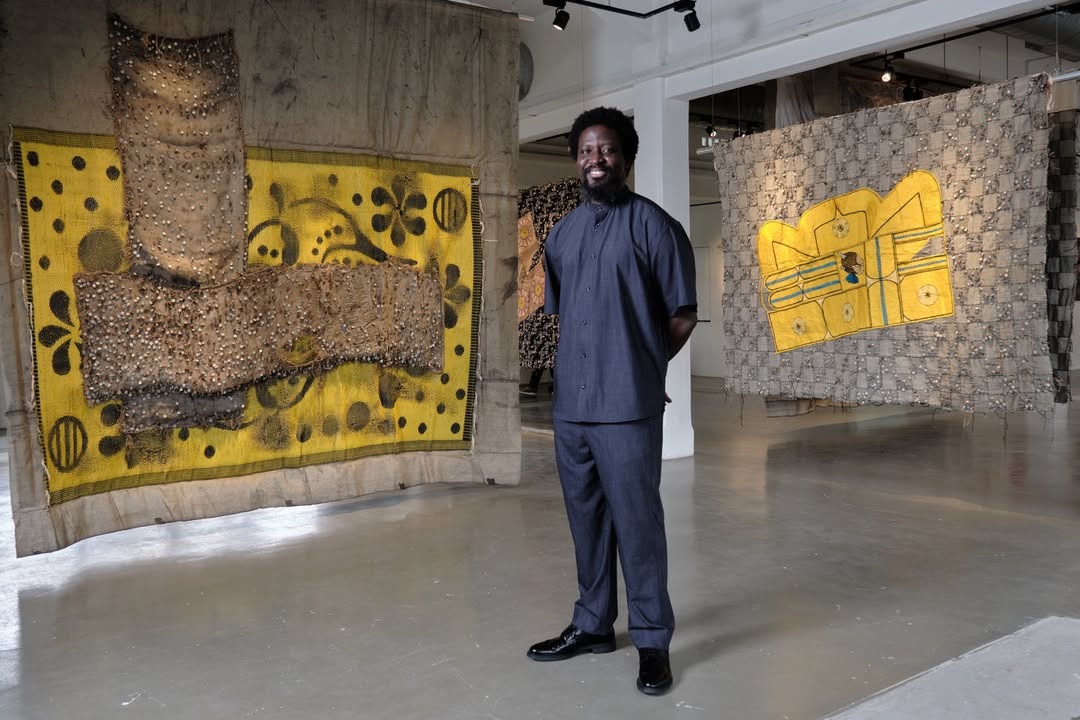
African labor histories were not framed as peripheral. They were central to the conversation.

Why This Matters

This is what it looks like when African artists shape global conversations.

Mahama’s work does not seek validation through scale or location alone. It asserts that African histories, material knowledge, and labor systems are essential to understanding the modern world. His practice moves beyond participation and into authorship.

At Bellafricana, this kind of work is prioritized. One that carries depth, rooted in lived realities, and that reminds us that African creativity has always been about more than aesthetics.

Exploring artists like Ibrahim Mahama reveals how contemporary African art continues to reshape global narratives not by asking for a seat at the table, but by redefining the conversation entirely.

Seeing African art take on deeper meaning on the global stage is not just encouraging. It is necessary. Not as a trend, but as a continuation of long-standing truths.

Top Creative Business Ideas for African Entrepreneurs

Have you ever sat down with creative business ideas and wondered whether it’s just a dream… or your next big business? If you’re a creative African entrepreneur, designer, artist, content creator, fashion visionary, or craft-maker, your moment is now. The creative economy in Africa is not just growing; it’s exploding with opportunity.

In this post, I’m breaking down six (or more) smart, creative business ideas you can actually start today. These aren’t just trendy side hustles; they’re ideas with real demand, real impact, and real potential to scale.

African shop

The Big Picture: Why Creative Businesses in Africa Are Booming

Before we dive into specific ideas, here’s why now is such a powerful time to build:

  • Tech + Creativity: Tools like AI, content platforms, and digital marketing are increasingly accessible, making it easier for creatives to launch business ideas.

  • Growing Middle Class: More Africans have disposable income, which means more demand for design-led products, local fashion, artisanal crafts, and unique experiences.

  • Sustainability Momentum: Eco‑friendly fashion, upcycled crafts, and socially responsible businesses are resonating more than ever.

  • Digital Markets: E-commerce is booming, Africans are buying online, and creatives can reach global audiences.

7 Creative Business Ideas to Explore

Creative business ideas Africa Branding and Packaging

Here are some of the most compelling and relevant creative business ideas you can start today in Africa:

  1. AI‑Powered Creative Services

    • Offer automated content tools, chatbots, or design automation to other small businesses. According to Jangaan Tech, African businesses are looking for AI solutions that save time and money.

    • Use no-code AI tools to help local creatives or entrepreneurs scale their operations.

  2. Digital Marketing & Content Creation Agency

    • Many African small businesses don’t yet know how to leverage social media, SEO, or email. Starting a specialised agency (for, say, fashion brands, artists, or craft businesses) can be massively valuable.

    • Combine storytelling + design to help clients build a brand, not just run ads.

  3. Online Learning & Skills Training Platform

    • Create courses for in-demand creative skills: graphic design, video editing, digital art, business for creatives, etc.

    • Offer this in local languages or via WhatsApp-based micro‑courses to reach underserved communities.

  4. Packaged African Food & Craft Manufacturing

    • Leverage local flavours. As urbanisation rises, there’s a huge opportunity for food startups that process and package local products.

    • On the craft side: turn traditional textiles, pottery, or recycled materials into globally sellable goods.

  5. Sustainable Fashion / Upcycled Accessory Brands

    • Use deadstock fabrics, recycled materials, or artisan techniques to build ethical fashion. Botswana’s Xita brand is a great example.

    • This kind of business resonates deeply with consumers who care about culture and the planet.

  6. Creative Fintech for SMEs

    • Create fintech solutions tailored for creativepreneurs: easy payments, micro-loans, and wallets for artisans.

    • Think voice-based interfaces or mobile-first tools, especially relevant in regions where smartphone and voice tech are strong. (Emerging research supports voice‑interface tools for SMBs.)

    • Artisanal Homeware & Heritage Crafts

    • Work with local artisans to create heritage-inspired pieces (baskets, ceramics, weaving) that appeal globally.

    • This taps into both the cultural value and the growing global market for ethically made, handcrafted goods.

Also Read: How The African Creative Business Is Turning Vision Into Legacy

How to Choose the Right Business Idea (For You)


Here’s a quick guide to help you pick which of the ideas above is the best path for your creative self:

  • Match to your skill + passion: What are you already talented at? What do you enjoy doing day in, day out?

  • Research local demand: Who are your potential customers? Are there gaps in your community or online that you can uniquely serve?

  • Start small, validate quickly: Build a minimum viable product (MVP), test it locally or online, and see how people respond.

  • Think scalability: Can the idea grow? For example, will your upcycled fashion brand scale across borders?

  • Leverage partnerships & networks: Collaborate with other creatives, hubs, or platforms so you don’t always go it alone.

Success Stories & Inspiration

To bring this to life, think about creators like One Rapelana of Xita (Botswana), who turned recycled clothing materials into bold, wearable art.

Also, there are creative hubs and social enterprises across Africa partnering with artisans, so you don’t have to reinvent the wheel. These networks are becoming more powerful, and you can tap into them.

Conclusion

If you’ve ever wondered whether your creative work could become more than a side hustle, whether it could grow into a brand, a movement, or even a business, this is your sign. The ideas above aren’t just dreams: they’re practical, timely, and deeply rooted in what the African creative economy needs right now.

If one of these ideas sparked something in you, start planning today. Pick one, research, test, and refine. Your talent can be more than a hobby it can become a thriving business. And remember, the right network and global perspective can accelerate every step of your journey.

STEPS TO MAKING

Massive Progress in your Business

Subscribe to get the free guide and learn step-by-step exactly what you need to achieve your goals.